Let's get the obvious out of the way: yes, you can get sick eating street food in Delhi. You can also get sick eating at a five-star hotel. The question is not whether to eat street food — the question is how to eat it well. Delhi has one of the great street food cultures in the world, and skipping it entirely means missing one of the deepest pleasures the city offers. This guide is for the traveler who wants to eat adventurously and intelligently, without spending three days in a hotel bathroom.
The standard advice — "boil it, cook it, peel it, or forget it" — is not wrong, but it is too blunt. The reality is more nuanced. Delhi's best street food vendors are skilled professionals with loyal followings, and their food is, in many cases, safer than the buffet at your hotel. The key is knowing how to distinguish the good vendors from the bad, and understanding which risks are real and which are paranoid.
The Rules That Actually Matter
1. High Turnover Is Everything
The single most important indicator of street food safety is turnover. A vendor who sells hundreds of portions a day is using fresh ingredients, because they don't have time to sit around. A vendor with no customers is using yesterday's chutney. This is the golden rule: eat where there is a crowd, especially a crowd of locals. A long queue is not an inconvenience — it is a quality certification.
The golden rule of Delhi street food: eat where there is a crowd of locals. A long queue is a quality certification, not an inconvenience.
2. Cooked to Order
Food that is cooked in front of you, at high heat, is almost always safe. The danger is not in the cooking — it's in the holding. A samosa that has been sitting in a glass case at 35°C for six hours is a bacterial incubator. A samosa that is pulled from a karahi of hot oil and handed to you on a plate is not. Prioritize vendors who cook to order, and avoid anything that looks like it has been sitting under a heat lamp.
3. Watch the Water
The most common cause of illness in Delhi is not the food — it is the water. And the most common way travelers encounter bad water is not by drinking it (most are careful about that) but through ice, through washed salads, and through chutneys that have been thinned with tap water. Here is the specific guidance:
- Ice: Avoid ice in drinks unless you are certain it is made from filtered water. Most street vendors cannot guarantee this. In restaurants, ask — the better ones use filtered water for ice.
- Chutneys: The green chutney at a street stall is often thinned with tap water. This is a real risk. Either skip it, or eat at vendors who use filtered water (the better ones in Old Delhi do, and will tell you if you ask).
- Salted lassi and buttermilk: These are made with water. Only drink them at established dairies or restaurants, not at cart vendors.
- Salads and raw vegetables: Avoid raw salads at street stalls. The vegetables may have been washed in tap water. Cooked vegetables are fine.
4. The Hand Rule
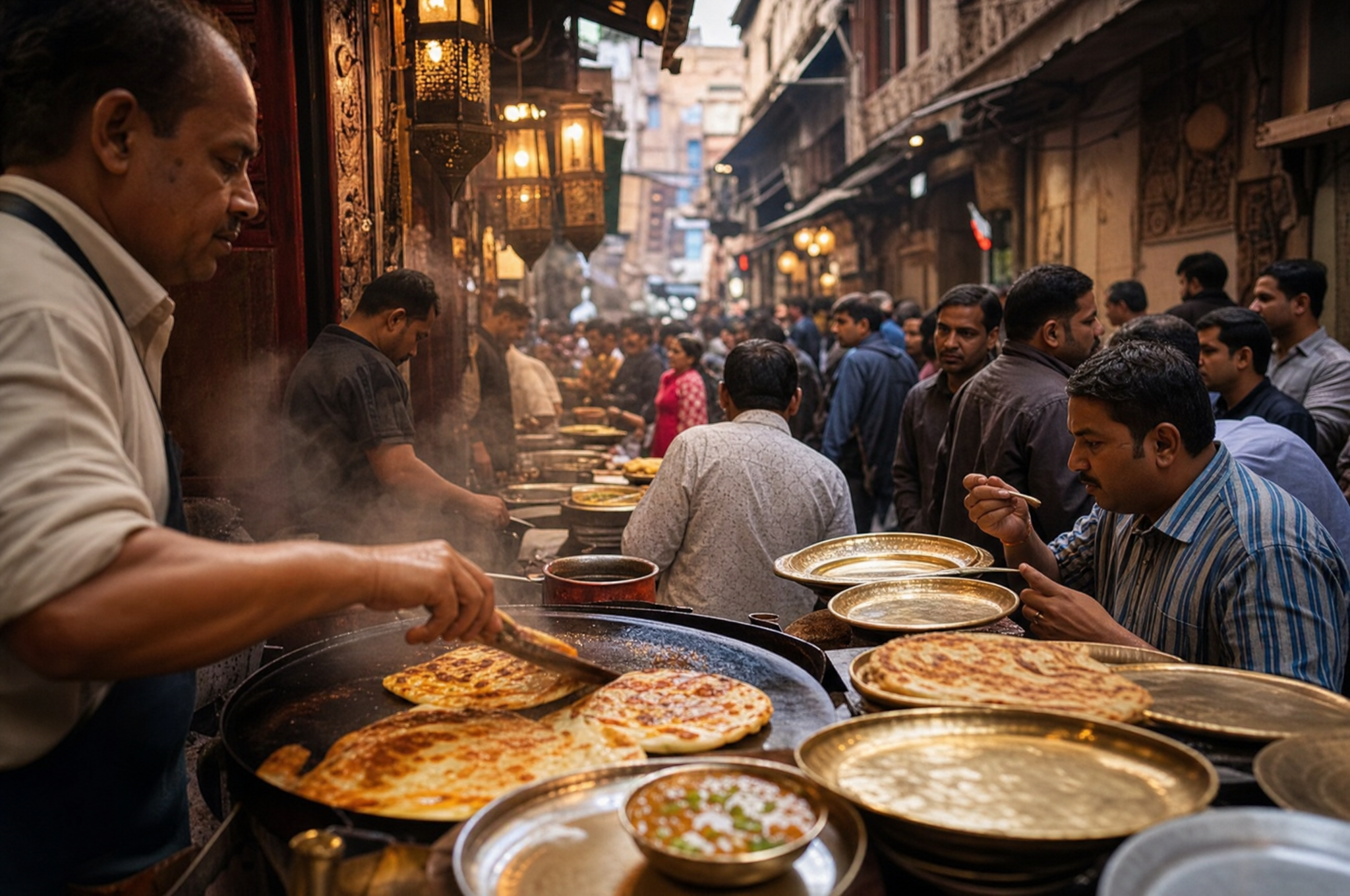
Watch the vendor's hands. Do they handle money and food with the same hand? Do they cough into the food? Do they have an assistant who handles the cash while they handle the cooking? These are not aesthetic preferences — they are genuine hygiene indicators. The best vendors in Old Delhi have systems: one person cooks, another takes money, and the hands never cross. If you see a vendor handling cash and then pressing a paratha with bare hands, walk away.
What to Eat (and What to Avoid) on Your First Few Days
If you are newly arrived in Delhi and your stomach is not yet acclimated, here is a graduated approach:
Safe from Day One
- Fried foods cooked at high heat: Samosas, kachoris, pakoras, jalebis. The oil kills everything. The risk is in the holding, not the cooking, so eat them fresh.
- Parathas and rotis: Cooked on a hot tawa, served immediately. The Paratha Wali Gali shops are safe by any standard.
- Tandoor-cooked breads and kebabs: The tandoor runs at 400°C+. Nothing survives that.
- Chai: Boiled for several minutes. Safe everywhere.
Proceed with Caution
- Chaat (gol gappa, papdi chaat, dahi bhalla): The risk is in the chutneys and the water. Eat at established vendors with high turnover. The famous chaat stalls in Chandni Chowk are generally safe; the cart outside your hotel may not be.
- Kulfi and ice cream: Only at established shops with refrigeration. Avoid the cart vendors.
- Lassi: Only at established dairies (Amul, Mother Dairy booths) or named restaurants.
Avoid Entirely (for New Arrivals)
- Cut fruit from carts: The fruit may have been cut hours ago and washed in tap water.
- Raw salads at street stalls: See above.
- Anything served at room temperature that should be served hot: If the gravy isn't steaming, skip it.
- Paan from unknown vendors: The ingredients are not always fresh, and the sweet varieties contain sugar syrup that can ferment.
The Acclimatization Principle
Here is something most guides won't tell you: your stomach can acclimatize. The first few days in Delhi are the riskiest, because your gut microbiome has not adapted to the local bacterial environment. Eat conservatively for the first 48 hours — restaurant food, cooked items, bottled water — and then gradually introduce street food as your system adjusts. By the end of a two-week trip, most travelers can eat broadly across the street food spectrum without issue.
This is not a license to be reckless. It is an acknowledgment that the body adapts, and that the goal is not to avoid all risk but to manage it intelligently. The traveler who eats nothing but hotel food for two weeks and then attempts a chaat crawl on their last night is more likely to get sick than the traveler who has been eating street food cautiously throughout their trip.
If You Do Get Sick
Despite all precautions, illness happens. Here is what to do:
Hydration is the priority. Delhi belly is usually a self-limiting gastrointestinal infection that resolves in 24–72 hours. The danger is dehydration. Drink ORS (oral rehydration salts), available at any pharmacy, mixed with bottled or filtered water. Avoid anti-diarrheal medications like loperamide for the first 24 hours — they can prolong certain bacterial infections by keeping the pathogen in your system.
When to see a doctor: If symptoms persist beyond 72 hours, if you develop a high fever, if you see blood in your stool, or if you become severely dehydrated (dizziness, dark urine, dry mouth), seek medical attention. Delhi has excellent private medical facilities; Max Healthcare, Fortis, and Apollo all have 24-hour clinics. Travel insurance usually covers the visit.
Antibiotics: Only take antibiotics if prescribed by a doctor after a stool test. Self-medicating with ciprofloxacin or azithromycin (which some travelers carry) is not recommended unless you are in a remote area without medical access. Most cases of Delhi belly are viral, not bacterial, and antibiotics won't help.
A Final Note
Delhi's street food culture is one of the great culinary traditions of the world, and it is worth the managed risk. The vendors at Chandni Chowk, the paratha shops of Gali Paranthe Wali, the chaat stalls of Dilli Haat — these are not dangers to be survived. They are experiences to be sought out, and with a little knowledge and a little caution, they will be among the best meals of your life.
Eat well. Eat widely. Eat where the locals eat. And carry ORS, just in case.