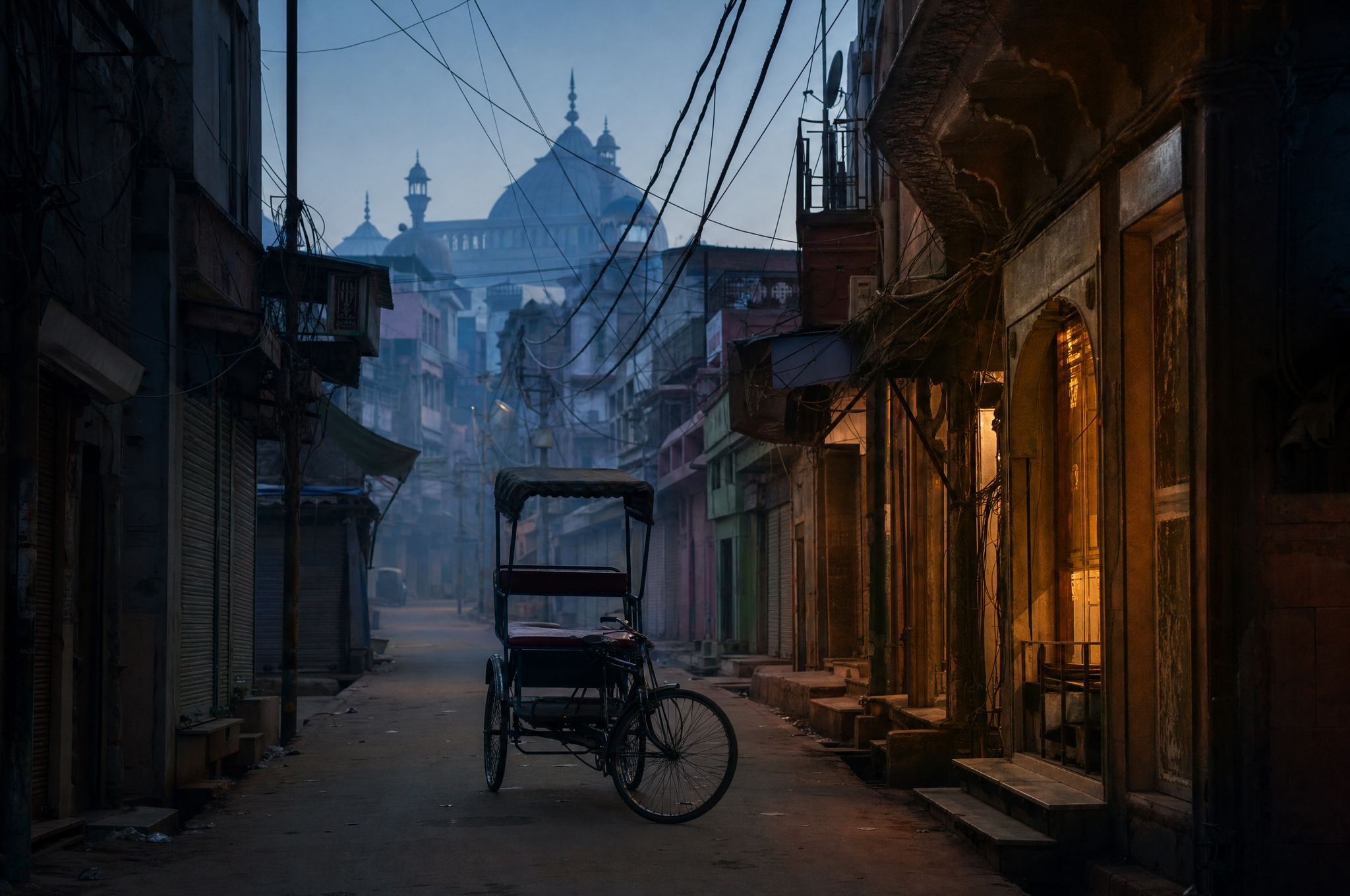
The muezzin's voice reaches you first — not from one mosque but from several, the calls overlapping like waves finding their rhythm. It is 5:14 in the morning, and Chandni Chowk is still dark. The streetlights cast a sodium orange over shuttered shopfronts, and the only sound besides the call to prayer is the distant clatter of a chai stall setting up its boiler. If you have only ever known Old Delhi at noon — a crush of rickshaws, honking, and bodies — this hour will feel like a different city entirely. It is. This is Shahjahanabad before it puts on its face.
The trick is to arrive by 5 AM, before the first Metro train discharges its passengers at Chawri Bazar. Walk east from the station toward the Red Fort, and you'll find the great boulevard of Chandni Chowk in a state of suspension. The wholesale traders have gone home. The retail shops haven't opened. In the gap, the street belongs to sweepers, stray dogs, milkmen on bicycles, and the occasional photographer who has learned that this is the only hour the walled city will hold still.
The Chai Stall at the Corner of Fatehpuri
Start at Fatehpuri Mosque, where the road bends. There is a chai stall here — it has no name, only a hand-painted board that reads "Chai 10/-" — that has been boiling milk since 3:30 AM. The owner, Iqbal, is a third-generation tea seller whose grandfather opened the stall in 1947. He serves the tea in kulhars, the terracotta cups that impart a faintly earthy taste, and he will tell you that the recipe has not changed in seven decades. Whether or not that's true, the tea is excellent: strong, sweet, boiled with crushed cardamom and ginger, and served at a temperature that demands patience.
This is also where you meet the other early risers. The morning regulars are a cast of Old Delhi characters: the uncle in his white kurta who walks four kilometers from Daryaganj every morning, the young bakery worker from Karim's who is finishing his night shift, the sweepers who maintain the mosque courtyard. They drink their tea in a companionable silence that feels almost ceremonial. Nobody checks a phone. The conversation, when it happens, is in a soft Urdu that you don't need to understand to recognize as affectionate.
"Yeh sheher subah ke liye bana tha," Iqbal says, pouring a second kulhar. "This city was made for the morning."
The Bread Ovens Wake Up
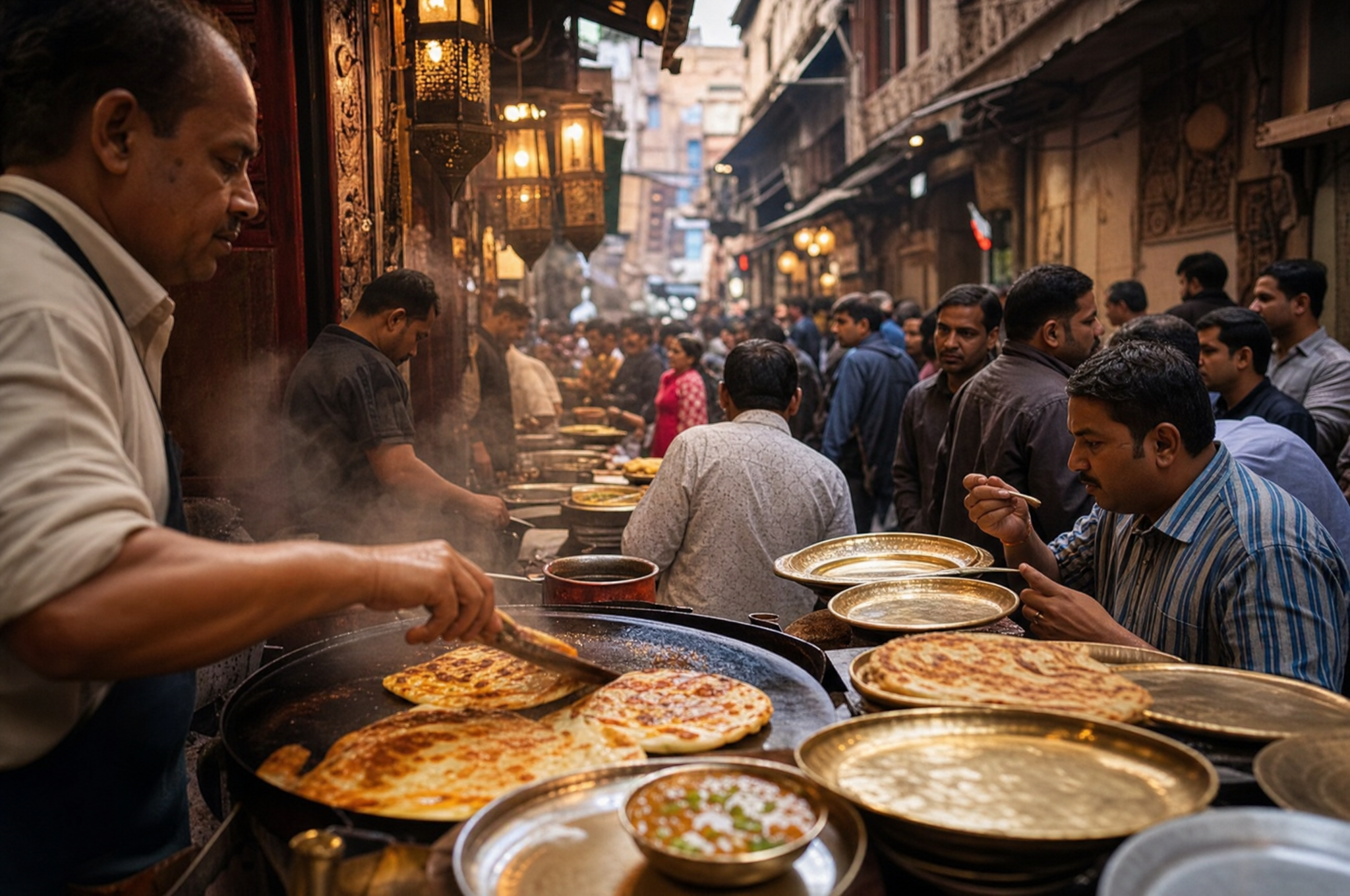
By 5:45, the first bakeries on the Gali Qasim Jan are firing their tandoors. These are not the famous kebab houses — those come later — but the humble bread bakeries that supply the neighborhood's rotis, sheermal, and bakarkhani. The ovens are wood-fired, built into the walls of Mughal-era havelis, and the bakers work with a rhythm that hasn't changed in centuries. Dough is slapped against the hot clay wall, peeled off when blistered and charred, and stacked into cloth-lined baskets that are carried out on bicycles to restaurants and homes across the walled city.
If you are lucky, one of the bakers will offer you a fresh sheermal — a saffron-tinted flatbread enriched with milk and ghee — straight from the oven. Eaten warm, it is one of the great breads of India, and you will not find a better version at any restaurant. This is the secret of Old Delhi's morning: the best food is not sold to tourists. It is made for the neighborhood, and it never leaves these lanes.
The Light Arrives
At 6:20, the light begins. It comes not from the east — the buildings are too tall for direct sunrise — but as a reflected glow that turns the upper stories of the havelis from gray to gold. The jharokhas, those ornate overhanging windows that Mughal architects designed for ventilation and women's privacy, catch the first light and hold it. For about twenty minutes, the street is painted in colors that do not exist at any other time of day: a warm amber on the sandstone, a cool blue in the shadows, and everywhere the texture of weathered plaster and carved wood.
This is the photographer's hour. But it is also the hour when the city begins to accelerate. The first delivery trucks arrive at the Kinari Bazaar intersection, bringing bolts of fabric and wedding decorations. The cycle rickshaw drivers emerge from wherever they sleep — many in their rickshaws, parked in rows along the Fort walls — and begin their slow patrol for the first fares. The vegetable vendors wheel their carts into position, arguing good-naturedly over who gets which corner. The street is filling, but gently, and there is still room to walk.
Jama Masjid Steps
Walk south from Chandni Chowk proper into the lanes that lead to Jama Masjid. The mosque's eastern gate faces a market street that is, at this hour, almost empty. Climb the steps — there are thirty-nine of them, worn smooth by three centuries of feet — and you will find the courtyard already open for morning prayers. The dawn namaz has concluded, but a few worshippers remain in private devotion, and the caretakers are beginning to sweep the vast sandstone expanse.
The view from the top of the steps is one of the great urban vistas of India: the entire walled city spread below you, the Red Fort to the east, the modern towers of Connaught Place visible beyond the rooftops, and the Yamuna river a silver line in the haze. It is a view that Shah Jahan's architects intended. The mosque was built to dominate, and it still does, even now that the city around it has grown so much taller.
Breakfast at Karim's
By 7:30, you will be hungry. Descend the mosque steps and walk one lane south to Karim's, the legendary restaurant founded in 1913 by the son of a Mughal royal chef. At this hour, the famous mutton biryani and kebabs are not yet ready — those come at lunch — but the breakfast menu is its own reward. Order the nihari: a slow-cooked stew of meat on the bone, simmered overnight with a spice blend that includes nutmeg, mace, and fennel. It is served with khameeri roti, a leavened bread baked in the tandoor, and a wedge of lemon. This is the breakfast that has fueled Old Delhi's working morning for over a century.
The nihari is not for the cautious. It is rich, heavily spiced, and unapologetically meaty. But it is also one of the most satisfying dishes you will eat in Delhi, and at 7:30 in the morning, after two hours of walking, it feels less like a meal than a reward. For a deeper dive into Old Delhi's food traditions, see our guide to the Paratha Wali Gali and our practical advice on eating street food safely in Delhi.
The City Turns On
Finish your tea, pay your bill, and step back onto the street. In the ninety minutes since you arrived, Chandni Chowk has transformed. The shutters are open. The rickshaws are full. The tourists are arriving with their cameras and their lists. The quiet hour is over, and the city's famous chaos is assembling itself with practiced efficiency.
But you have seen the other city — the one that exists only at the edge of dawn, before the volume goes up. It is still there, underneath the noise, and it will be there again tomorrow at 5 AM. You only have to wake up for it.