Imagine a public park where your morning jog takes you past a fifteenth-century tomb, a sixteenth-century bridge, and a glasshouse where Indira Gandhi once held cabinet meetings. This is Lodhi Gardens, a ninety-acre landscape in the heart of New Delhi that manages to be simultaneously a serious archaeological site, a prestigious jogging track, and the most pleasant place in the capital to read a book under a tree. No other park in India — perhaps no other park anywhere — combines monuments of this significance with a landscaping sensibility this refined.
The gardens sit on what was once the Khairpur village area, a site that has been used for burials and monumental construction since the fifteenth century. The land passed through the hands of the Sayyid and Lodhi dynasties — both pre-Mughal rulers of the Delhi Sultanate — and then the Mughals, before the British incorporated it into the new imperial capital in the 1930s. Lady Willingdon, wife of the then Viceroy, ordered the village cleared and the tombs landscaped into a formal garden in 1936. The village was relocated; the tombs remained. The park was originally named Lady Willingdon Park, but was renamed Lodhi Gardens after independence.
The Monuments
The gardens contain monuments spanning roughly a century of Delhi's architectural history, from the mid-fifteenth to the mid-sixteenth century. Walking clockwise from the main gate on Lodhi Road, you encounter them in roughly chronological order:
Muhammad Shah's Tomb (circa 1444)
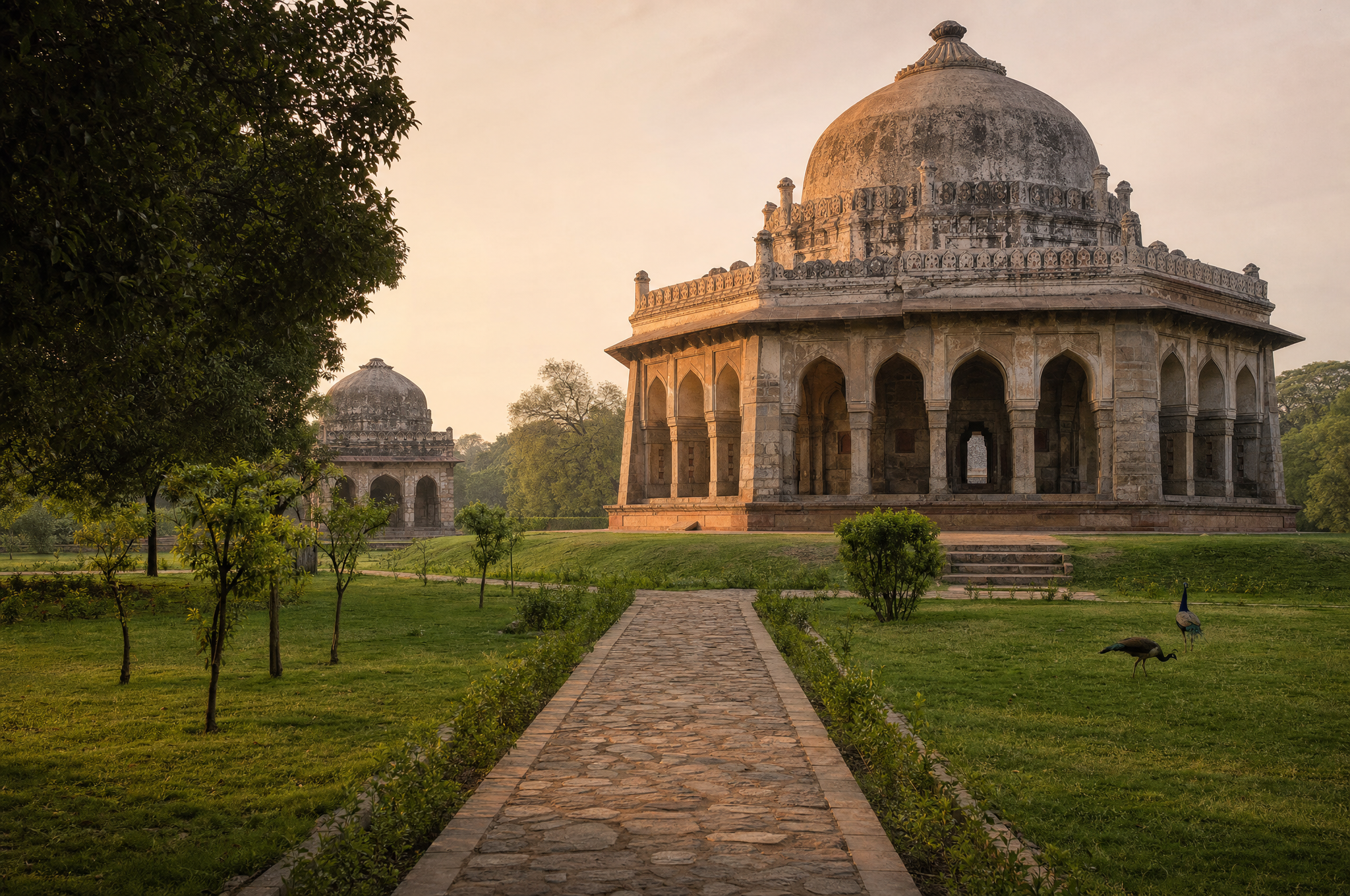
The oldest major structure in the gardens, this octagonal tomb was built for the third ruler of the Sayyid dynasty. It sits in a raised octagonal enclosure, with a central chamber surrounded by a verandah of arches. The dome is characteristically pre-Mughal — sloping shoulders, a restrained lotus crown — and the absence of a double dome marks it as earlier than the Lodhi-era tombs. Look for the Hindu motifs on the chhajja (eave) brackets; the Sayyid period was a time of architectural transition, and the fusion of Islamic structural forms with Hindu decorative elements is visible here.
Bara Gumbad Complex (circa 1494)
The most imposing structure in the gardens. The Bara Gumbad ("big dome") is not actually a tomb — its central chamber contains no grave — but rather a massive gateway attached to a mosque and a guesthouse. The mosque, with its fine stucco decoration and Hindu-inspired brackets, is one of the best-preserved pre-Mughal mosques in Delhi. The facade has a restrained elegance that prefigures the Mughal aesthetic by half a century.
The Bara Gumbad is a puzzle. Why build a gateway to nowhere, attached to a mosque and a guesthouse, with no tomb? Some scholars believe it was a ceremonial entrance to a larger complex that was never completed.
Shish Gumbad (circa 1500)
Opposite the Bara Gumbad, this tomb takes its name ("glass dome") from the blue and green tile work that once covered its facade. Most of the tiles have fallen away, but fragments remain, giving a sense of the original effect — which must have been striking. The interior contains several unidentified graves, possibly members of the Lodhi family.
Sikandar Lodhi's Tomb (circa 1517)
The only Lodhi tomb enclosed by a fortified wall, this structure sits in the northwest corner of the gardens and is arguably the most significant monument here. Sikandar Lodhi was the most powerful ruler of the Lodhi dynasty, and his tomb — with its double dome, formal garden setting, and defensive enclosure — anticipates the Mughal garden-tomb tradition that would culminate a century later at Humayun's Tomb. The wall and gateway are worth studying; the scalloped arches on the gateway are a Persian motif that the Mughals would later make their own.
Athpula ("Eight-Pier Bridge")
A seven-arched stone bridge spanning what is now a dry streambed, built during Akbar's reign in the late sixteenth century. It is the latest dated structure in the gardens and a reminder that this area was once a functioning landscape of streams and gardens, not just a monumental cemetery.
The Morning Walk
But the monuments are only half the story. Lodhi Gardens is, for most Delhi residents, primarily a park — and one of the best in the city for a morning walk. The gardens open at 6 AM (sunrise in summer, slightly later in winter), and by 6:30 the paths are full. The demographic is specific: government officials from the nearby bungalows, diplomats from the embassies in Chanakyapuri, fitness enthusiasts of all ages, and a steady stream of retired couples who have been walking these same paths for decades.
The walking circuit is roughly three kilometers if you follow the outer path, and it takes you past every major monument in the gardens. The terrain is flat, the paths are well-maintained, and the tree cover — neem, amaltas, semal, arjun — provides shade through most of the route. There is a rose garden in the southwest corner, a bamboo grove near the Athpula, and a small lake where you can sit and watch parakeets and kingfishers.
The early morning light on the tombs is, for photographers, one of the great visual experiences of Delhi. The sandstone glows. The shadows are long. The joggers provide human interest against the ancient architecture. Arrive by 6:15 in summer, 7:00 in winter.
The Glasshouse and the Bonsai Park
In the center of the gardens sits a glasshouse — a small Victorian-style conservatory that now houses a collection of tropical plants. It was built by Lady Willingdon as part of the original landscaping, and it is one of the few colonial-era structures in the gardens that has been maintained in its original form. Nearby is the National Bonsai Park, a small but excellent collection of bonsai trees maintained by the Bonsai Society of India. It is open only on weekends and is worth a visit for the quality of the specimens.
Practical Information
Lodhi Gardens is free to enter and open daily from 6 AM to 7:30 PM (closes earlier in winter). The main entrance is on Lodhi Road, opposite the India International Centre; there are additional gates on Max Mueller Marg and on Subramaniam Bharti Marg. The nearest Metro station is Jor Bagh (Yellow Line), about a ten-minute walk. There are no food stalls inside the gardens — this is a park, not a market — but the India International Centre and the Lodhi Hotel are both within walking distance for a post-walk coffee.
The gardens are safe at all hours, and they are one of the few public spaces in Delhi where women walking alone will feel entirely comfortable. The only caution is the monkeys, which are present in large numbers and can be aggressive if you carry food. Do not feed them.
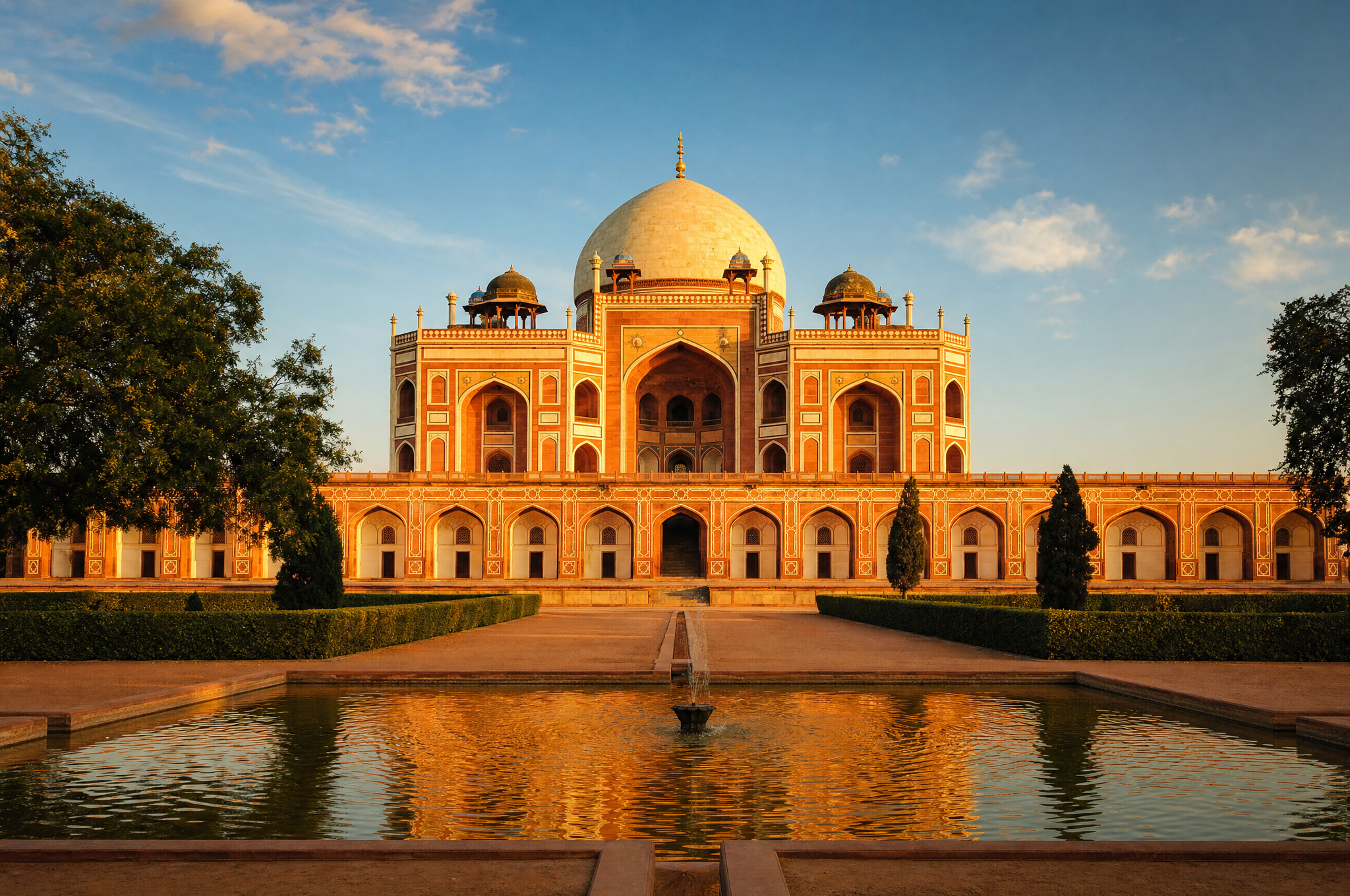
For those interested in exploring more of Delhi's architectural heritage, the gardens are a short walk from Humayun's Tomb and a short drive from the Qutub Minar complex. Together, these three sites tell the story of five centuries of Delhi's architectural evolution — from the pre-Mughal Sultanate to the height of Mughal power.