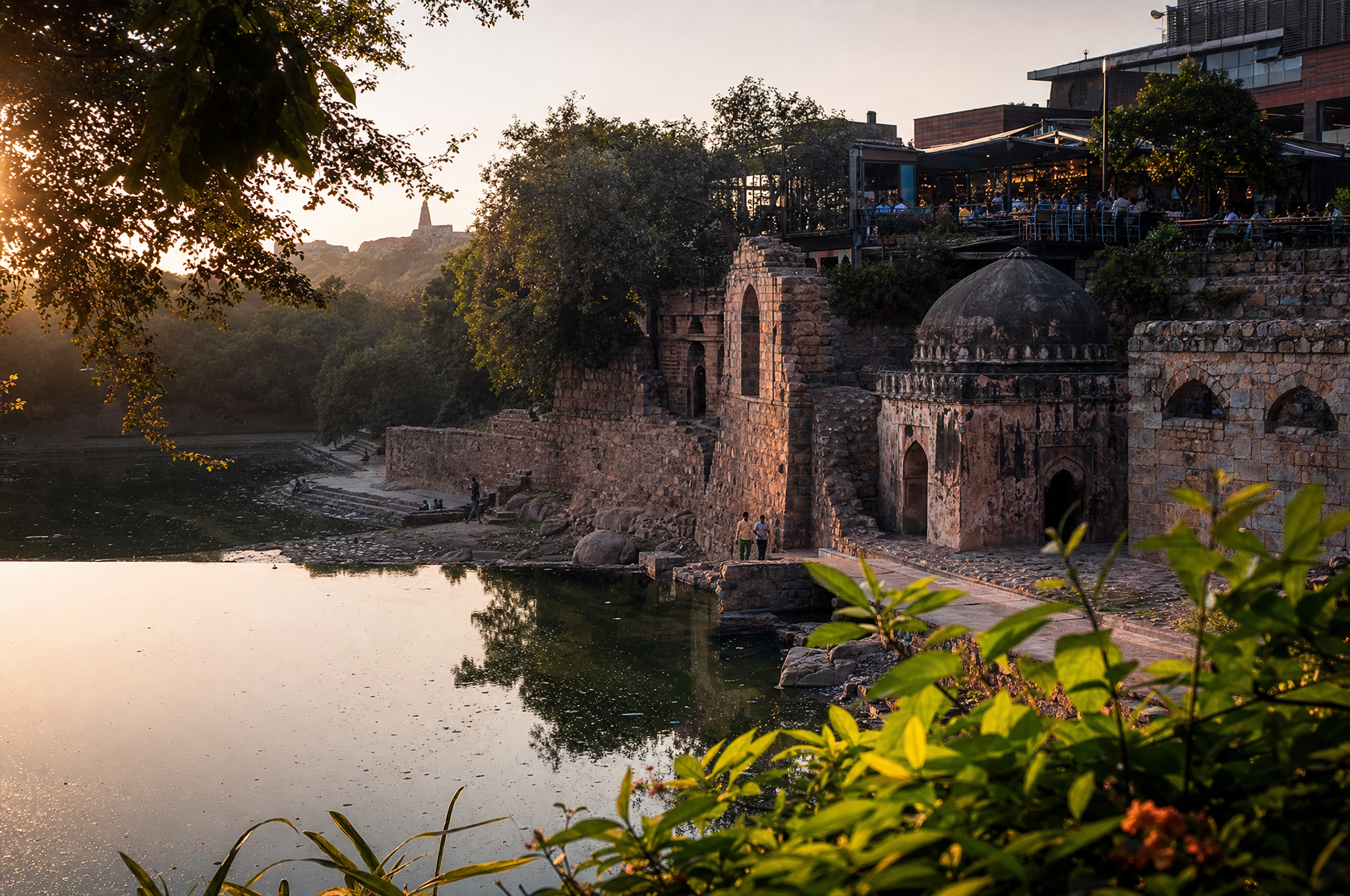
Stand at the edge of the Hauz Khas reservoir at sunset and look in two directions. To the south, the water reflects the domes and arches of a fourteenth-century madrasa, its sandstone glowing amber in the last light. To the north, the rooftops of Hauz Khas Village — a warren of designer boutiques, art galleries, and cocktail bars — hum with the noise of a neighborhood that has somehow become one of Delhi's primary nightlife destinations. The juxtaposition is absurd, and it is entirely intentional, and it is the reason this neighborhood is worth understanding.
Hauz Khas Village is not, despite the name, a village. It is a narrow lane of converted havelis and residential buildings in south Delhi, sitting on a ridge above a fourteenth-century water tank. The lane dead-ends at the Hauz Khas archaeological complex — the ruins of a madrasa, a tomb, and a pavilion built by Firuz Shah Tughlaq in the 1350s — and the entire neighborhood exists in the gravitational pull of those ruins. Everything here, from the property prices to the restaurant hours, is shaped by the fact that a medieval Islamic seminary sits at the end of the street.
The Reservoir and the Madrasa
The story begins in the late thirteenth century, when Sultan Alauddin Khilji ordered the construction of a large reservoir — a hauz — to serve the people of Siri, his new capital. The tank fell into disrepair after Khilji's death, but it was restored and expanded fifty years later by Firuz Shah Tughlaq, who also built the madrasa on its eastern and northern edges. The madrasa was one of the leading centers of Islamic learning in the fourteenth-century Islamic world — a fact that is easy to forget when you're standing in its ruins watching a DJ set up on the rooftop above.
The complex is now maintained by the Archaeological Survey of India and is free to enter. It is one of the most atmospheric historical sites in Delhi, partly because the ruins are genuinely impressive — the madrasa's two-story arcades and domed chambers are among the finest Tughlaq-era structures in the city — and partly because the reservoir, which was de-silted and restored in the 2000s, attracts a large population of water birds. Walk the perimeter of the tank at dawn and you will see herons, egrets, cormorants, and, if you're lucky, a family of resident painted storks.
The madrasa at Hauz Khas was, in the fourteenth century, one of the leading centers of Islamic learning in the world. The students who studied here would walk the same arcades you can walk today.
How the Village Happened
The "village" designation is a legacy of Delhi's land records, which classified this area as a lal dora (red line) settlement — a village exempt from the building regulations that govern the rest of the city. In practice, this meant that the land could be used more flexibly, and in the 1980s, a series of artists, designers, and boutique owners began moving into the narrow lane, attracted by the low rents, the proximity to the ruins, and the exemption from commercial zoning restrictions.
The transformation was gradual at first — a gallery here, a designer's studio there — and then, in the late 2000s, it accelerated. Cafés opened. Bars followed. The lane, which had been quiet enough for artists to work, became, by 2012, one of the loudest streets in south Delhi. The property prices rose accordingly. The artists who had made the neighborhood interesting were, in many cases, priced out. The boutiques that replaced them catered to a clientele that was less interested in art and more interested in cocktails with a view.
What's Worth Seeing Now
Despite the gentrification, Hauz Khas Village remains one of the most interesting neighborhoods in Delhi — if you know where to look. Here is the editorial shortlist:
The Ruins (Morning)
Go at 7 AM, before the complex fills with joggers and selfie-takers. The light on the madrasa is best between 7:30 and 8:30, and the birds are most active early. Walk the full perimeter of the tank, then climb to the upper level of the madrasa for the view back across the water. The Firuz Shah's tomb, a modest domed chamber attached to the madrasa, is worth entering for its plaster decoration, which survives in fragments.
The Deer Park
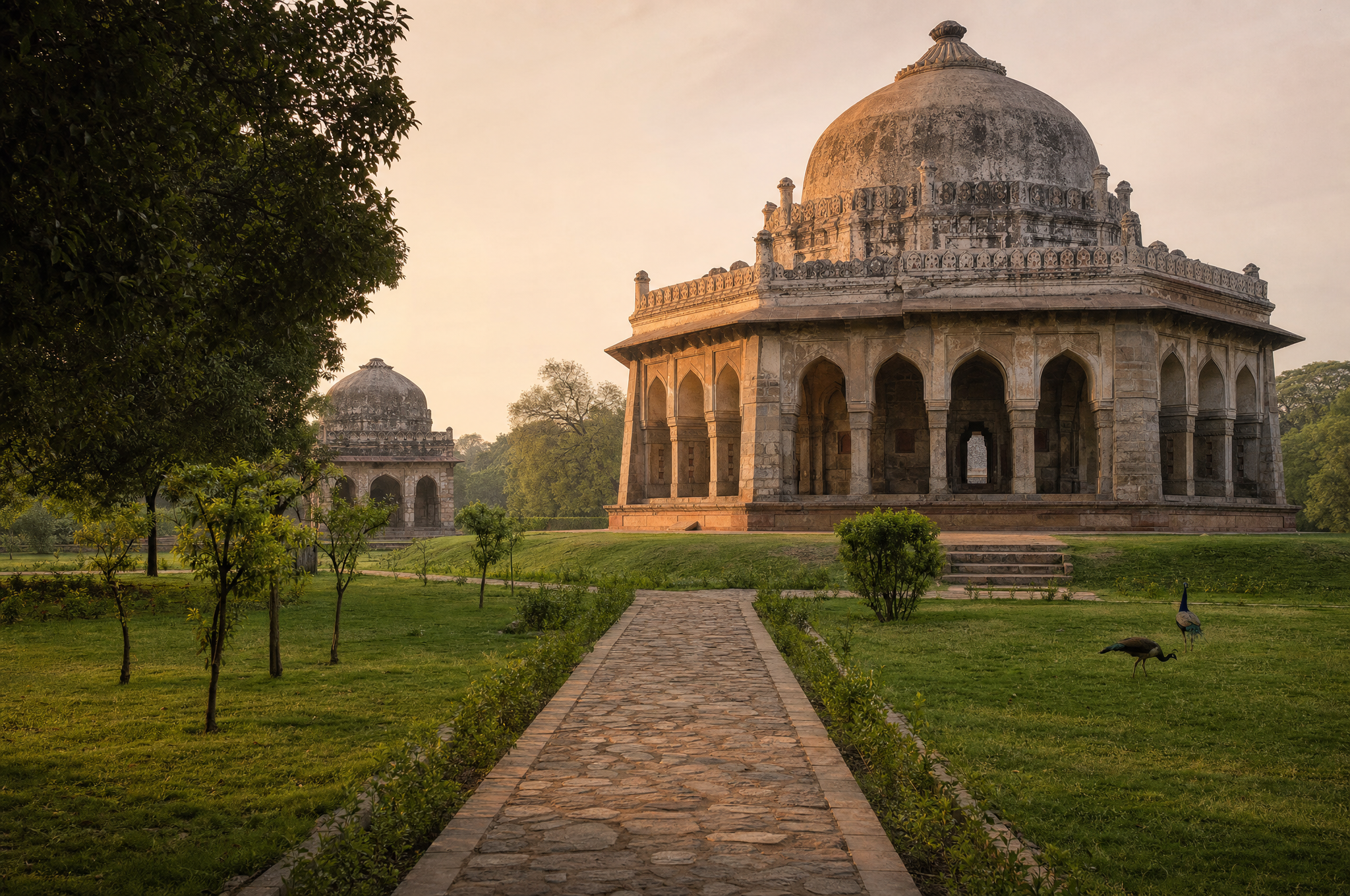
Adjacent to the ruins, the Deer Park is a six-acre green space containing — as the name suggests — a herd of spotted deer, as well as a population of rabbits and peacocks. It is a favored jogging spot and a pleasant place to walk off a heavy lunch. The park connects to the larger Hauz Khas District Park, which extends south toward the IIT Delhi campus.
The Boutiques
A few of the original design shops survive. Look for Nappa Dori (leather goods and stationery), Bodice (Ruchika Sachdeva's label, which won the International Woolmark Prize in 2018), and any of the small jewelry studios on the upper floors of the lane. The quality is variable, so browse before you buy, and remember that "Hauz Khas Village" on a label does not automatically mean handcrafted.
The Cafés (Afternoon)
The café culture here is, frankly, uneven. Many of the rooftop establishments are better for their views than their food, and the noise level in the evening makes conversation difficult. For a quiet afternoon coffee, try Amour Bistro (on the reservoir side, with a terrace overlooking the water) or Rose Café (around the corner in Shahpur Jat, a short auto ride away). For dinner, book a table at Gunpowder, the southern Indian restaurant that has been here since before the boom and remains, by some margin, the best restaurant in the Village.
When to Go, and When to Avoid
Hauz Khas Village is a very different place at different times. Here is the guide:
- Early morning (6–9 AM): The ruins and the Deer Park are at their best. The lane is quiet. The cafés are closed. This is the time for history and bird-watching.
- Late morning to afternoon (10 AM–4 PM): The boutiques are open, the cafés are serving brunch, and the crowds are manageable. This is the time for shopping and a leisurely lunch.
- Evening (5 PM onward): The rooftop bars open, the music starts, and the lane fills with south Delhi's nightlife crowd. If you want to experience the Village as a nightlife destination, this is the time. If you don't, leave before 5.
- Weekends: Avoid unless you are specifically coming for the nightlife. The lane is too narrow for the crowds, and the experience degrades quickly.
For a deeper dive into Delhi's other neighborhood transformations, see our guide to Mehrauli, Delhi's oldest continuously inhabited area, or our exploration of Chandni Chowk in the walled city. For more green spaces, Lodhi Gardens offers a more serene version of the ruin-meets-park experience.